



By Mumo Judah
June 2, 2026
BEIRUT, Lebanon — A US-brokered partial ceasefire in Lebanon is under severe strain after overnight clashes and rocket exchanges continued in the country’s south, raising doubts over the durability of the limited agreement announced earlier this week.
US President Donald Trump had declared that both sides had agreed to “stop all shooting,” presenting the development as a breakthrough aimed at reducing escalating hostilities. However, officials have since clarified that the arrangement is geographically limited and does not amount to a comprehensive nationwide ceasefire.
The deal, brokered on June 1, 2026, ahead of planned Lebanese-Israeli diplomatic talks in Washington, establishes a restricted understanding between the parties focusing on specific areas and forms of engagement.
Under the terms of the agreement, Israel is expected to halt heavy bombardment of Beirut and the Hezbollah-controlled southern suburbs of Dahiyeh, while Hezbollah has agreed to cease rocket and drone attacks directed at Israeli territory.
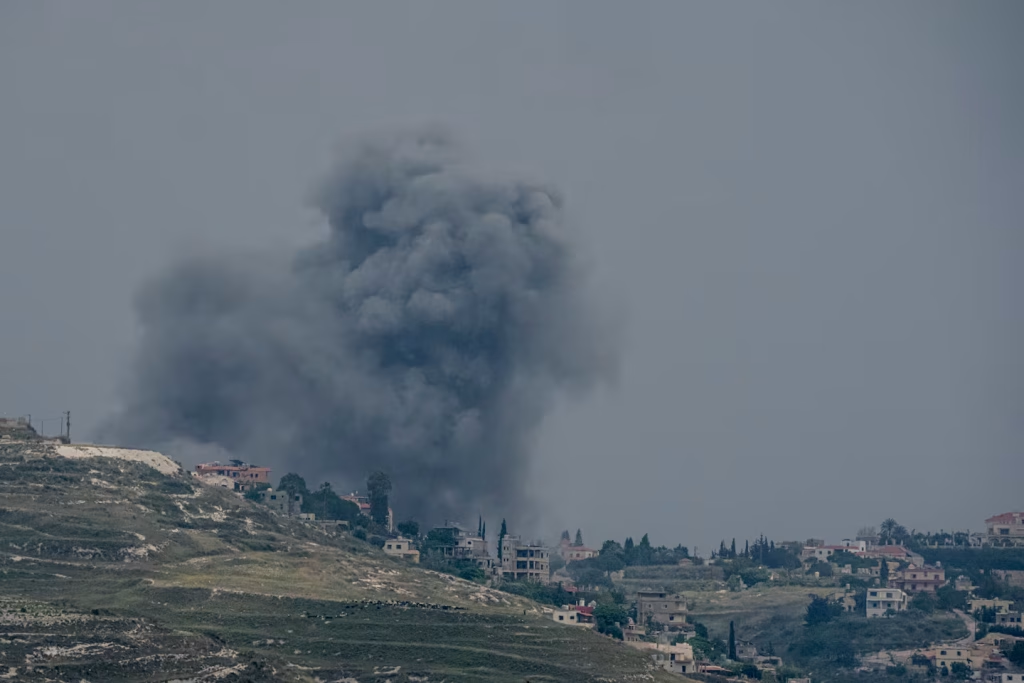
Despite this, fighting has continued in southern Lebanon, where the agreement does not explicitly impose a halt to ground operations, leaving the region outside the scope of the partial truce.
Israeli Prime Minister Benjamin Netanyahu confirmed the pause in strikes on Beirut but stressed that Israeli ground forces would continue operations in the south “as planned.” Israeli troops have reportedly pushed deeper into southern Lebanese territory, with advances extending toward the Zaharani River, marking their most significant incursion in the area in 25 years.
On the ground, Hezbollah has continued armed resistance, targeting Israeli tanks with missiles and artillery in border towns including Haddatha and Bayada. The group maintains that it will continue fighting until a full ceasefire is reached and Israeli forces withdraw completely from Lebanese territory.
Tensions were further heightened by reports from the Israeli military that two projectiles were intercepted after being launched from Lebanese territory into northern Israel early Tuesday, an incident seen as an immediate breach of the agreement’s cross-border restrictions.
The fragile truce comes amid wider regional diplomatic maneuvering involving the United States and Iran. Tehran has warned that continued Israeli military operations in Lebanon could undermine an already delicate US-Iran understanding, prompting Washington to intensify efforts to contain the escalation.
Lebanese officials are reportedly hoping that the limited arrangement will serve as a foundation for broader negotiations in Washington aimed at securing a more permanent and comprehensive ceasefire.
However, with continued fighting in the south and competing interpretations of the agreement, the situation remains highly unstable, and prospects for lasting calm remain uncertain as hostilities persist on the ground.