



By Mumo Judah, St. Petersburg, June 3, 2026
Ukrainian long-range drones struck key energy and military installations in St. Petersburg on Wednesday, targeting critical infrastructure in an attack that coincided with the opening of Russia’s flagship international economic forum and underscored Kyiv’s growing ability to project force deep inside Russian territory.
The strikes, which Ukrainian officials described as a deliberate operation against strategic assets supporting Russia’s war effort, targeted the St. Petersburg Oil Terminal, the Kronstadt naval base and a weapons-manufacturing facility in Russia’s Tambov region. The operation represents one of the most politically symbolic attacks on President Vladimir Putin’s hometown since the start of the war.
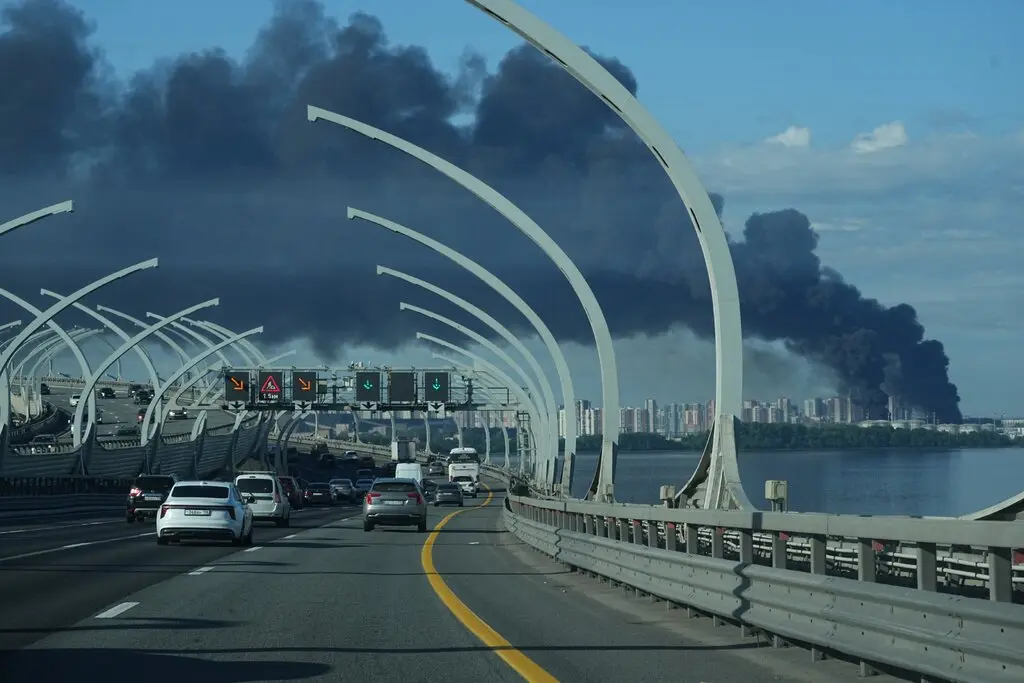
Ukrainian President Volodymyr Zelensky said the drones travelled more than 1,000 kilometres to reach their targets, demonstrating the increasing range and sophistication of Ukraine’s long-distance strike capabilities. Footage circulating on social media and Russian media platforms showed thick black smoke rising from the vicinity of the oil terminal near the city’s port facilities following the attack.
Russian authorities reported that air defence systems intercepted dozens of drones during the overnight assault. Officials said 59 drones were shot down across various regions, though several managed to reach their intended targets. The attack prompted authorities to temporarily suspend operations at Pulkovo Airport, one of Russia’s busiest air hubs, while regional officials also ordered mobile internet disruptions in an effort to interfere with drone navigation systems.
According to St. Petersburg Governor Alexander Beglov, several people sustained injuries during the attacks, though no fatalities were reported within the city. Emergency services were deployed to affected sites as authorities worked to assess the extent of the damage.
The timing of the operation carried significant political and economic implications. The strikes occurred as the St. Petersburg International Economic Forum (SPIEF) officially opened, an event often referred to as the “Russian Davos” because of its role as Russia’s premier platform for attracting investment and showcasing economic resilience.
For years, President Putin has used the annual forum to demonstrate Russia’s economic strength and reassure international investors despite mounting geopolitical tensions and sanctions. However, the attack cast a shadow over this year’s gathering, highlighting the growing reach of Ukraine’s aerial campaign and raising fresh concerns about the vulnerability of Russia’s strategic infrastructure.
Although many Western governments and multinational corporations have largely distanced themselves from the forum since Russia’s invasion of Ukraine in 2022, the event continues to attract delegations from countries maintaining economic ties with Moscow. This year’s edition includes a notable business delegation from Saudi Arabia, while reports indicate that a smaller American delegation is also in attendance.
Ukrainian security officials suggested the operation was designed to target the economic foundations of Russia’s war effort, particularly infrastructure linked to the country’s energy sector, which remains a crucial source of government revenue. Analysts note that attacks on oil facilities have become an increasingly important component of Ukraine’s strategy to pressure Moscow economically while demonstrating that critical assets far from the frontlines are no longer beyond reach.
The Kremlin swiftly condemned the strikes, with spokesman Dmitry Peskov accusing Ukraine of escalating attacks against civilian and economic infrastructure. He said Russia’s response operations inside Ukraine had already assumed a “systematic” character and signalled that retaliatory measures would continue.
The latest drone offensive came just one day after a major Russian missile and drone barrage struck Kyiv and several other Ukrainian cities, killing at least 22 civilians and injuring dozens more. The exchange highlights the intensifying cycle of retaliation that has come to define the conflict as both sides increasingly rely on long-range aerial warfare.
As the war enters its fifth year, Ukraine and Russia continue to expand their drone capabilities, turning energy facilities, transport hubs, military installations and industrial centres into key targets in a broader struggle aimed at weakening each other’s economic capacity and public morale.
The St. Petersburg attacks are likely to further fuel concerns over the security of Russia’s critical infrastructure and could intensify pressure on authorities to strengthen air defence systems around major economic and political centres. At the same time, they serve as a reminder that the conflict is increasingly extending far beyond the battlefield, with strategic economic assets becoming central targets in a war that shows little sign of ending.