


By Joshua Otieno | April 9, 2026
NAIROBI, KENYA — William Ruto has clarified that the current collaboration between the national government and Johnson Sakaja’s administration is a “partnership,” not a transfer of functions, as he moved to ease concerns over increased national involvement in city affairs.
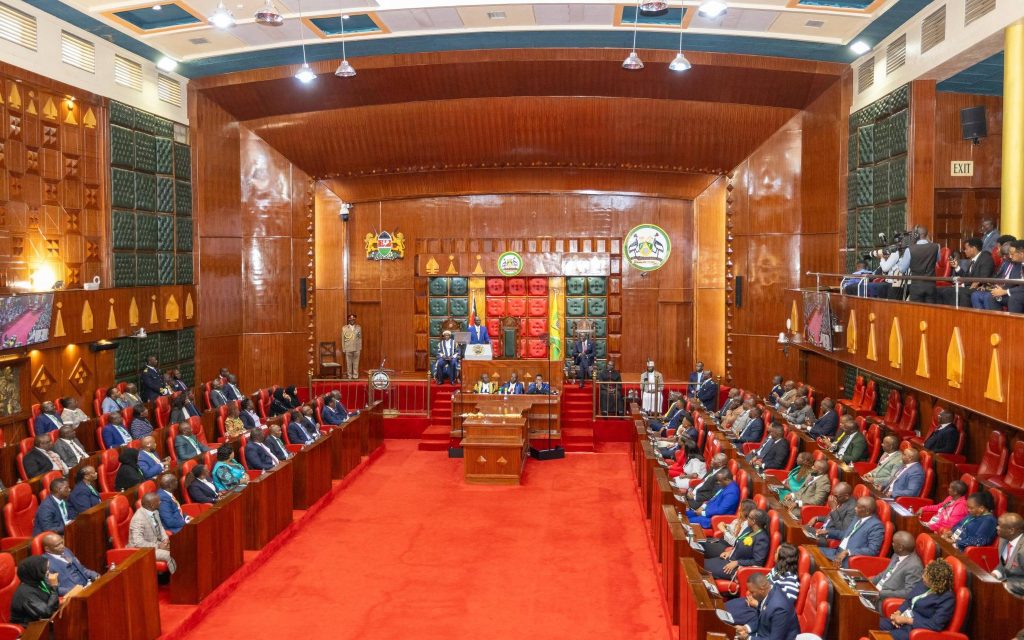
Speaking during a historic address to the Nairobi City County Assembly, the President emphasized that, unlike the defunct Nairobi Metropolitan Services (NMS) arrangement, all constitutional powers remain with the county government.
“We are not undertaking any transfer of functions. We are supporting the county to deliver on its mandate.”
Ruto underscored that the partnership model is designed to accelerate the government’s Bottom-Up Economic Transformation Agenda (BETA), particularly in key sectors such as housing, healthcare, and education.
The President’s remarks came as he unveiled a sweeping KSh 80 billion joint development pact aimed at transforming Nairobi over the next 24 months.
“The era of drift is over—it is now time for execution.”
Key projects under the ambitious plan include the installation of 50,000 streetlights, major road recarpeting works, expansion of sewer systems, and increased electricity access in informal settlements.
In the education sector, the national government has already handed over Moi Forces Academy to the county to operate as a public school, while also supporting the expansion of the “Dishi na County” school feeding programme.
Ruto also announced a renewed crackdown on criminal cartels undermining service delivery, particularly in waste management and illegal construction.
“We must take the cartels in Nairobi City head-on… However powerful they may be, you have the National Government’s support to do it.”
In a significant environmental directive, the President revealed that even State House would not be exempt from enforcement measures targeting illegal developments on riparian land.
“I have directed the immediate demolition of a section of State House’s perimeter wall… no property, including State House, will be exempt from environmental enforcement.”
Governor Sakaja welcomed the partnership, noting that the collaboration has unlocked billions in development funding and accelerated long-stalled infrastructure projects across the capital.
The President further described Nairobi as a “national asset,” stressing the need for coordinated governance to address long-standing urban challenges and deliver tangible results for residents.
Despite political criticism from some leaders who accused the national government of micromanaging the city, Ruto maintained that the new framework respects devolution while ensuring efficient service delivery.
With implementation already underway, the “Nairobi Rising” initiative is expected to significantly reshape the capital’s infrastructure, service delivery, and economic outlook in the coming years.