


By Erestinah Jane, June 30, 2026
President William Ruto has challenged his political opponents to account for their own development records, saying the government’s achievements in infrastructure and economic transformation speak louder than political criticism.
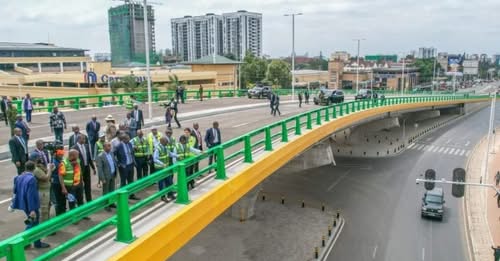
Speaking on today, during the unveiling of new infrastructure projects, the President said his administration remains focused on delivering its manifesto despite sustained attacks from critics.
Ruto argued that the difficult economic decisions taken since he assumed office are beginning to yield visible results, particularly in roads, housing, agriculture, healthcare and education.
“We are not interested in politics of insults or empty rhetoric. Let those who want to lead this country tell Kenyans what they have done and what they plan to do,” the President said.
He maintained that the Kenya Kwanza administration would continue prioritising development over political contests, insisting that citizens would judge leaders based on tangible projects rather than campaign slogans.
At the centre of the government’s latest development agenda is the National Infrastructure Fund, a financing mechanism established to mobilise domestic resources for major projects while reducing dependence on external borrowing.
According to the President, the fund will support large-scale transport and urban development projects expected to stimulate economic growth, improve connectivity and create employment opportunities.
Among the flagship initiatives is an ambitious programme to dual approximately 2,500 kilometres of major highways and tarmac an additional 28,000 kilometres of roads over the next ten years. One of the key projects is the planned KSh110 billion expansion of the Rironi–Mau Summit highway, a critical transport corridor linking Nairobi to western Kenya and neighbouring East African countries.
The government also intends to extend the Standard Gauge Railway (SGR) from Naivasha through Kisumu to Malaba, a move expected to strengthen regional trade by connecting Kenya’s railway network with neighbouring countries.
In Nairobi, the government has unveiled an initial KSh80 billion urban mobility programme that includes the construction and rehabilitation of more than 70 kilometres of roads across the capital, alongside the installation of 50,000 street lights within six months to enhance security, improve traffic flow and support the city’s night-time economy.
The President further highlighted the KSh100 billion Northern Kenya Gateway Corridor, a 750-kilometre road network connecting Isiolo, Wajir and Mandera. He said the project is designed to unlock economic opportunities, improve access to essential services and address decades of infrastructure deficits in northern Kenya.
Ruto dismissed criticism from political opponents, arguing that they have shifted attention to what he termed “peripheral issues” because they cannot challenge the government’s record on development.
He cited progress in affordable housing, agricultural reforms, education programmes and the rollout of Universal Health Coverage as evidence that his administration is fulfilling its campaign promises.
The President challenged opposition leaders to present practical alternatives on economic management, job creation and national development rather than relying on criticism of the government.
He reaffirmed that the Kenya Kwanza administration would remain focused on implementing projects aimed at improving livelihoods, insisting that the true measure of leadership lies in delivering tangible results that positively transform the lives of ordinary Kenyans.