


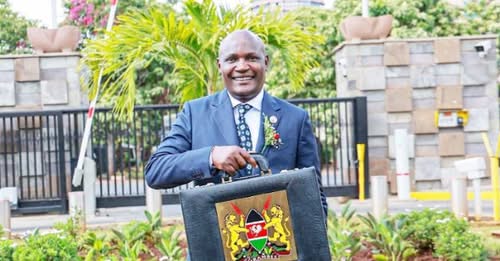

By Fridah Mbuvi, June 11, 2026
Treasury Cabinet Secretary John Mbadi has unveiled Kenya’s record KSh4.84 trillion budget for the 2026/2027 Financial Year, outlining an ambitious spending plan aimed at stimulating economic growth while maintaining fiscal discipline amid mounting pressure over the high cost of living.
Presenting the budget in Parliament on Thursday, Mbadi said the government’s priorities would focus on strengthening social services, expanding infrastructure, and reducing dependence on external borrowing.
To finance the expenditure, the Treasury projects total revenues of KSh3.67 trillion. Ordinary tax collections are expected to contribute KSh2.9 trillion, while appropriations-in-aid are projected at KSh644 billion. External grants from development partners are expected to add another KSh44 billion.
Despite the revenue projections, the budget faces a financing gap of between KSh1.1 trillion and KSh1.2 trillion. To bridge the deficit, the government plans to rely heavily on domestic borrowing, with KSh995.7 billion expected to be raised from the local market. External borrowing has been limited to KSh116.2 billion as part of efforts to contain the country’s debt burden.
Mbadi said the Treasury would avoid introducing punitive tax measures and instead focus on improving tax administration by sealing loopholes, enhancing compliance, and expanding electronic monitoring systems.
Education emerged as the biggest beneficiary in the spending plan, receiving KSh781.4 billion. The allocation will support higher education financing and facilitate the absorption of 20,000 intern teachers into permanent and pensionable terms.
The National Government’s recurrent expenditure has been allocated KSh1.98 trillion to cater for salaries, debt servicing and operations across ministries and state agencies.
Meanwhile, KSh840.6 billion has been earmarked for development projects, including roads, electricity connectivity and water infrastructure.
The health sector will receive KSh175.5 billion to support Universal Health Coverage and the Primary Healthcare Fund, while housing and urban development has been allocated KSh138.2 billion, including KSh50 billion for the affordable housing programme aimed at creating jobs and addressing the housing deficit.
The Treasury also plans to set aside KSh83 billion to settle pending bills owed to suppliers and contractors, a move expected to improve liquidity and stimulate economic activity.
However, analysts have warned that the government’s heavy reliance on domestic borrowing could crowd out the private sector by reducing access to credit and pushing up interest rates.
Concerns have also been raised over revenue assumptions after the Kenya Revenue Authority missed its nine-month revenue target ending March 2026 by KSh161.9 billion. Economists caution that lower-than-expected collections could force the government to introduce supplementary budget cuts later in the financial year.
Even so, Mbadi expressed confidence that the budget would support economic recovery while safeguarding fiscal sustainability, saying the government remains committed to balancing development needs with prudent financial management.