


By Perez Karisa, June 26,2006
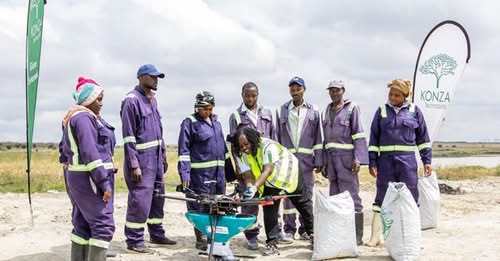
The Technopolis Development Authority (TDA) has successfully completed a landmark ecological restoration exercise at the Konza Technopolis Wildlife Conservancy, using drone technology to disperse thousands of indigenous tree seeds across degraded land in a major step towards environmental conservation and climate resilience.
The technology-driven initiative, announced on June 24, 2026, saw drones distribute 75 kilogrammes of bio-protected seedballs containing more than 36,000 indigenous tree seeds across a 1,000-acre section of degraded savannah within minutes. The project demonstrated how emerging technologies can significantly accelerate large-scale ecosystem restoration while reducing the time, labour and costs associated with conventional tree-planting methods.
Unlike traditional restoration efforts that require teams of workers to manually plant seedlings over several days, the drone deployment enabled rapid and precise seed dispersal across remote and difficult-to-access terrain. The operation targeted degraded sections of the conservancy, ensuring indigenous vegetation is reintroduced in areas requiring ecological recovery.
The restoration programme focused on three native tree species selected for their ecological importance and ability to thrive in the local environment. These include the Wild Olive (Olea africana), the Shittah tree (Acacia species), and the Fever tree, all of which play a critical role in restoring biodiversity, improving soil quality and supporting wildlife habitats within the conservancy.
The seeds were dispersed in specially designed bio-protected seedballs made from a mixture of nutrient-rich charcoal dust, clay and compost. The protective coating shields the seeds from extreme temperatures, insects and birds while preserving moisture until sufficient rainfall triggers germination. According to the Technopolis Development Authority, the seedball technology increases germination rates by approximately 80 per cent compared to planting bare seeds directly into the soil.
Speaking on the initiative, Annah Musyimi, the Authority’s Chief Manager for Physical Planning, Compliance and Environment, said the project demonstrates the growing importance of the Konza National Drone Corridor in advancing innovative environmental solutions.
Musyimi noted that the corridor continues to serve as Kenya’s dedicated, state-sanctioned testing and validation facility for advanced Unmanned Aircraft Systems (UAS), supporting innovations in agriculture, environmental management, scientific research and other strategic sectors. She said the successful restoration exercise illustrates how drone technology can be deployed beyond commercial applications to address pressing environmental challenges, including land degradation and climate change.
The project positions Konza Technopolis at the forefront of integrating technology with environmental conservation, reinforcing Kenya’s commitment to sustainable development while showcasing the potential of drone-enabled restoration to rehabilitate degraded ecosystems on a large scale.