




By Brian Rajula | November 18, 2026
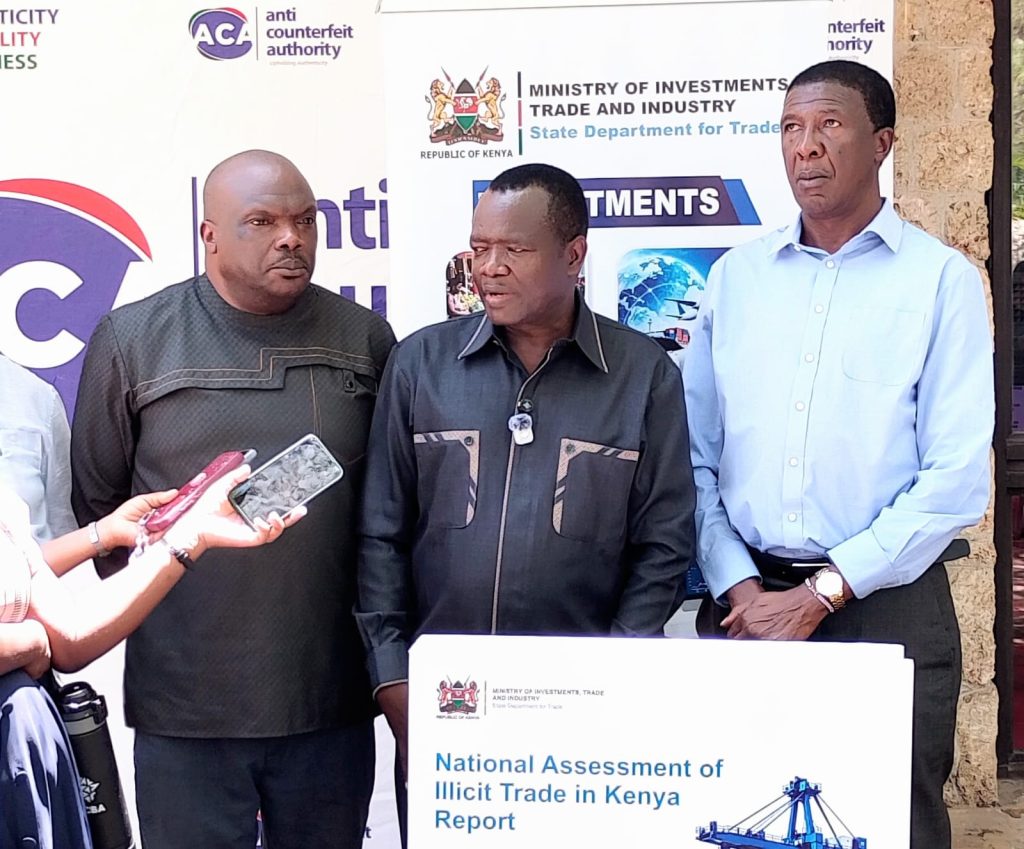
Kenya is losing billions of shillings to illicit trade, with counterfeit products accounting for approximately one quarter of goods in the national market, according to a new government assessment launched in Mombasa on 18th november 2026.
The findings were unveiled during the opening of the Third International Symposium on Intellectual Property Protection and Enforcement (ISIPPE-3), which has brought together government officials, enforcement agencies, regulators, judges and industry leaders from Africa, Europe, Asia and the Americas.
The two-day symposium, hosted by the Anti-Counterfeit Authority (ACA) in partnership with the Ministry of Investments, Trade and Industry, is being held at the Mombasa Continental Resort under the theme “Stepping Up the Fight Against Counterfeiting to Safeguard Public Health and Safety.”
The newly launched report, titled National Assessment of Illicit Trade in Kenya: Trends, Effects and Strategic Responses, indicates that illicit trade accounts for 25.2 per cent of Kenya’s national market, meaning approximately one in every four products in circulation is associated with illicit trade.
The assessment further reveals that manufacturing companies lose an average of 25 per cent of their market share to illicit trade, translating to approximately KSh 3.9 million per affected business. Companies impacted by the practice also reported a 25.5 per cent decline in employment.
The report highlights serious concerns in the alcohol and agricultural sectors, indicating that up to 60 per cent of certain alcohol categories and up to 89 per cent of some pesticides in the market could be counterfeit or illegally repackaged.
It also estimates that digital piracy costs Kenya’s creative industries more than KSh 92 billion annually, alongside approximately KSh 17 billion in lost tax revenue.
The findings further show that customs authorities detected illicit trade valued at KSh 13.58 billion, with false declarations accounting for 79.8 per cent of the total and an associated revenue liability of KSh 2.27 billion.
Speaking during the launch, Industrialisation Secretary Prof. Erastus Gatebe, who delivered remarks on behalf of Principal Secretary for Industry Dr Juma Mukhwana, warned that counterfeiting and illicit trade continue to undermine Kenya’s manufacturing ambitions.
“Kenya must become a manufacturer, and not just a market. Counterfeiting and illicit trade are among the most serious obstacles to that ambition,” Mukhwana said in his remarks.
He noted that manufacturing contributed 7.1 per cent of Kenya’s Gross Domestic Product (GDP) in 2025 and employs close to 390,000 Kenyans in formal jobs, with sector growth improving to 4.4 per cent in the first quarter of 2026.
Mukhwana said the State Department for Industry would strengthen intellectual property protection through industrial support programmes, promote the adoption of product authentication and traceability technologies, and enhance cooperation between the Kenya Industrial Property Institute and the Anti-Counterfeit Authority.
Meanwhile, Anti-Counterfeit Authority Board Chairperson Nelson Ributhi Gaichuhie called for practical measures to address the problem, noting that the international symposium should move beyond discussions and deliver concrete solutions.
He said the first symposium in 2023 helped establish the challenges facing intellectual property protection, while the second edition in 2024 developed a reform agenda.
“ISIPPE-3 must produce action, through the Mombasa Action Points that will be adopted at the close,” Gaichuhie said.
ACA Executive Director Dr Robi M. King’a said counterfeit products pose significant risks to both the economy and public health, identifying alcoholic beverages, agricultural inputs, pharmaceuticals, motor vehicle spare parts, electrical goods and building materials among the most counterfeited products in Kenya.
“Counterfeit goods are not just an economic concern; they are a direct threat to lives,” he said, warning that counterfeit alcoholic drinks containing methanol can cause blindness or death in quantities as small as 10 millilitres.
King’a also revealed that ACA inspectors, working alongside the Kenya Revenue Authority, intercepted a 23-tonne consignment of counterfeit pesticides at the Port of Mombasa last year.
The choice of Mombasa as the host city reflects its strategic position as a major gateway for trade serving East and Central Africa. This year’s symposium also marks the first time the international event has been held outside Nairobi.
The National Assessment updates the 2020 National Baseline Survey, which estimated that illicit trade cost the country KSh 826 billion in 2018, an amount larger than the manufacturing sector’s entire contribution to the economy at the time.
The symposium continues on Thursday, November 19, with sector-specific discussions covering pharmaceuticals and medical equipment, energy, electrical and electronic products, as well as alcohol and tobacco.
Delegates are expected to adopt the Mombasa Action Points at the conclusion of the meeting, outlining measures to strengthen enforcement, improve border controls, accelerate legal action against counterfeiters and promote product traceability.
The implementation of the report’s recommendations is expected to involve a coordinated approach among government agencies, manufacturers and other stakeholders, with the ultimate goal of protecting consumers, supporting legitimate businesses and strengthening Kenya’s manufacturing sector.


