


By Perez Karisa, June 24, 2026
The World Health Organization (WHO) has raised concern over the rapidly spreading Ebola outbreak in the Democratic Republic of Congo (DRC), confirming that the epidemic has already recorded 1,048 confirmed cases and 267 deaths, making it the deadliest first month of any Ebola outbreak in Africa’s history.
According to health authorities, the outbreak, which was officially declared on May 15, 2026, is being driven by the rare Bundibugyo strain of the Ebola virus, for which no approved vaccines or specific treatments currently exist. Experts believe the virus had been circulating undetected for several months before authorities officially announced the epidemic.
WHO data shows that the outbreak reached the grim milestone of 250 deaths within just 37 days. By comparison, the 2014–2016 West Africa Ebola epidemic took 78 days to reach the same number of fatalities, while the 2018–2019 outbreak in eastern DRC required 130 days.
Health officials attribute the unprecedented pace of transmission to the virus reaching major urban centres, including Bunia and the gold-mining town of Mongbwalu. Previous outbreaks were largely confined to remote rural areas, making containment measures easier to implement.
The situation has been worsened by the spread of infections into at least three overcrowded displacement camps in eastern Congo. The International Organization for Migration (IOM) has confirmed at least 25 infections and 14 deaths among displaced communities, raising fears of further transmission in vulnerable populations with limited access to healthcare.
Efforts to contain the outbreak have also been complicated by insecurity in eastern DRC. Continued attacks and the presence of armed groups, including the Allied Democratic Forces (ADF), have hindered access to several affected areas and disrupted contact-tracing operations.
Health officials say tracing teams have only managed to achieve approximately 55 per cent contact coverage, while investigators have yet to identify the outbreak’s index case, commonly referred to as “patient zero.”
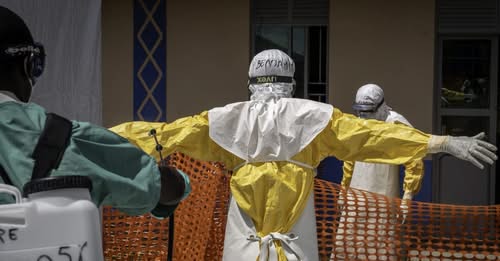
Despite the challenges, WHO and the Africa Centres for Disease Control and Prevention (Africa CDC) have intensified emergency response efforts. Authorities have expanded Ebola treatment capacity to more than 500 beds across affected regions to accommodate the increasing number of patients.
International partners have also launched a joint emergency response plan valued at 518 million US dollars aimed at strengthening disease surveillance, laboratory testing, case management and community protection measures.
The WHO has warned that the outbreak remains a major regional and global public health concern, emphasizing the need for stronger international support and enhanced security to enable health workers to access affected communities and slow the spread of the disease.
Health experts continue to urge neighbouring countries to strengthen surveillance systems and preparedness measures to prevent cross-border transmission as efforts to contain the epidemic continue.