



BY HILTON MWASELA |SEPTEMBER 8, 2026
A new political demand is taking shape in Western Kenya, and it could become one of the defining issues in the negotiations ahead of the 2027 General Election.
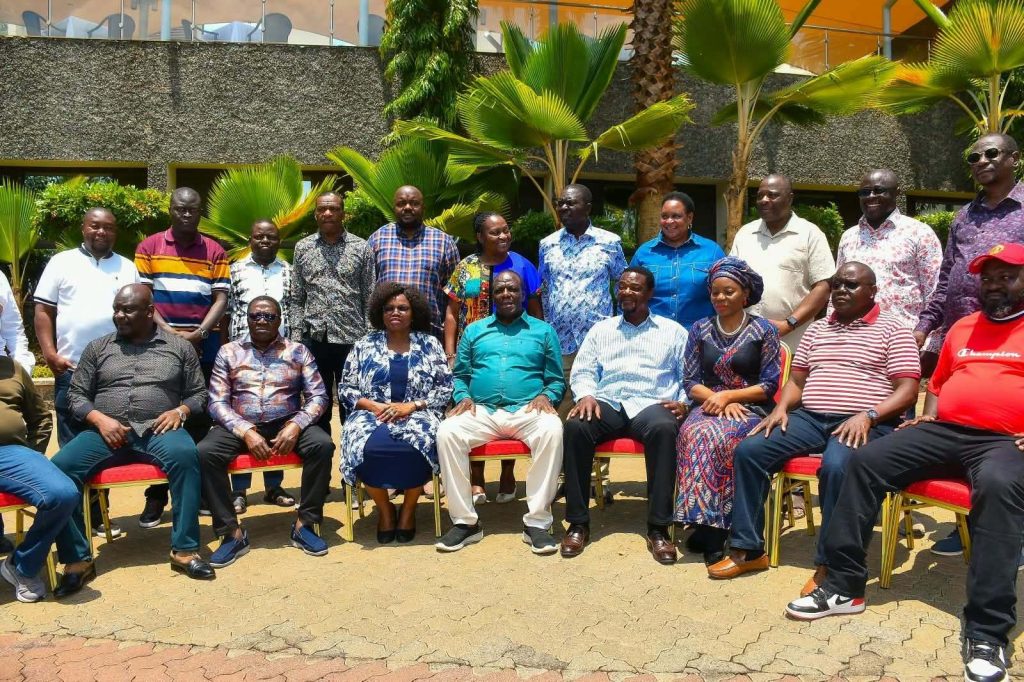
More than 23 Members of Parliament from the region allied to the Broad-Based Government have called for Western Kenya to be considered for the Deputy President’s position in President William Ruto’s 2027 re-election bid.
Speaking after a meeting in Kisumu, the MPs declared their support for President Ruto while at the same time demanding greater political representation for the region. They also raised concerns over stalled government projects and challenges facing the sugar industry.
Their message was direct: “As Western community, we demand the seat of the Deputy President to deputize H.E President William Samoei Ruto in the next general election.”
But beneath that political demand lies a much bigger question: Is Western Kenya bargaining for political power, or is it bargaining for development?
The reality is that in Kenyan politics, political positions are rarely just about titles. A powerful office comes with influence, and influence can determine which issues receive attention when national priorities are being discussed.
Western Kenya is an important electoral bloc, and its leaders are clearly attempting to convert that electoral strength into political bargaining power ahead of 2027. That is part of democratic politics, and there is nothing inherently wrong with it.
However, political bargaining becomes problematic when the position itself becomes the ultimate prize.
The ordinary voter does not wake up every morning asking which community occupies the Deputy President’s office. The questions are much more basic and immediate: Can I get a job? Can I afford food? Can my child access quality education? Can my family afford healthcare? Can farmers earn a decent income? Can small businesses survive?
That is where the debate should become more serious.
The Deputy President is not constitutionally a regional representative. Article 147 of the Constitution describes the Deputy President as the principal assistant of the President who deputises for the President in executing presidential functions.
Therefore, whoever occupies that office must serve the entire Republic of Kenya, regardless of where they come from.
If Western Kenya eventually gets the Deputy President’s position, the bigger question should not simply be what that person will do for the region. It should be what they will do for Kenya.
The country cannot afford to turn the Deputy President’s office into a permanent contest among ethnic and regional blocs. If every community approaches presidential politics with the argument that it deserves the number two position because it delivered votes, national leadership risks becoming an endless auction of political positions.
That is not the Kenya envisioned by the Constitution.
But Western Kenya’s leaders also have a legitimate point when they demand greater representation.
Every region has political and development interests, and the MPs have connected their demand for representation to specific concerns, including stalled government projects and the struggling sugar sector.
This is where the region’s political leadership should go further.
If Western Kenya is going to negotiate for the Deputy President’s seat, it should not negotiate for the seat alone. It should negotiate for a clear development agenda.
The region should demand better roads, agricultural value addition, investment, youth employment, quality healthcare, education and the revival of the sugar industry. It should push for factories, stronger markets for farmers and an economic transformation plan with targets that ordinary citizens can see and measure.
A Deputy President from Western Kenya without tangible transformation in Western Kenya could easily become nothing more than a political trophy.
And Kenyans do not eat political trophies.
The other important question is who exactly the political leaders are speaking for when they say Western Kenya deserves the Deputy President’s seat.
Are they speaking for MPs? Political parties? Businesspeople? Farmers? Young people? Workers? Or the wider electorate?
These groups do not necessarily have identical interests.
A political elite can agree on a powerful government position while ordinary citizens remain preoccupied with unemployment, food prices and the cost of living. Political leaders should therefore be careful not to assume that electoral support automatically translates into unconditional support for a political deal.
The voter must remain at the centre of the conversation.
The demand also exposes the changing politics of the Broad-Based Government as the 2027 election approaches. What may have started as an arrangement aimed at political cooperation, stability and governance is increasingly being viewed through the calculations of the next election.
As political actors begin asking what the arrangement offers them ahead of 2027, questions surrounding coalitions, running mates, regional representation and succession naturally become more prominent.
Western Kenya is effectively sending a message: If our political support matters, then our representation must also matter.
That is a legitimate political argument.
But there should be another question: What does Western Kenya offer Kenya beyond its votes, and what development agenda does it want to advance through that political influence?
This brings us to the danger of ethnic arithmetic.
Kenya has seen political coalitions built around communities, constituencies and voting numbers. Leaders count votes, negotiate positions and calculate political alliances. But after elections, citizens are often left asking where the jobs, industries, affordable healthcare and agricultural transformation are.
The country therefore needs to move from ethnic arithmetic to policy arithmetic.
Instead of asking how many votes Western Kenya brings, political leaders should ask how many jobs a political arrangement will create.
Instead of asking which community gets the Deputy President, Kenyans should ask what the Deputy President will deliver.
Instead of focusing on who gets which government position, the political debate should centre on what measurable targets the next government will achieve.
That is the political conversation Kenya deserves.
Western Kenya’s political leaders must also confront another reality: whether they can negotiate as one.
The region has several influential politicians with competing interests and ambitions. Recent political developments have highlighted competition among leaders, including tensions involving Cooperative and SMEs Cabinet Secretary Wycliffe Oparanya and Kakamega Governor Fernandes Barasa, alongside other leaders seeking greater influence.
A divided negotiating team has limited bargaining power.
If one leader wants one position, another wants a different position and another wants control of the political machinery, the region risks negotiating against itself.
The question should therefore not simply be, “Who should be Deputy President?”
The bigger question should be, “What common agenda can Western Kenya agree on?”
Once that agenda is established, the question of who occupies the office becomes secondary.
Western Kenya can demand the Deputy President’s seat.
But the people of Western Kenya should demand something much bigger: development, opportunity and measurable results.