



By Erestinah Jane | July 7, 2026
The United States has rolled out a new foreign assistance framework that replaces traditional aid with binding bilateral health agreements, marking a major shift in Washington’s global health policy under the Trump administration’s America First Global Health Strategy.
The policy follows the dissolution of the United States Agency for International Development (USAID) and introduces more than US$14 billion in medium-term health partnerships with 34 countries, including 24 African nations, to support programmes targeting HIV, malaria and tuberculosis.
Unlike previous funding arrangements, the new Memorandums of Understanding (MOUs) channel assistance directly through recipient governments rather than non-governmental organizations (NGOs). The agreements also require participating countries to make financial commitments of their own and, depending on the negotiated terms, may include provisions relating to commercial cooperation or public health data sharing.
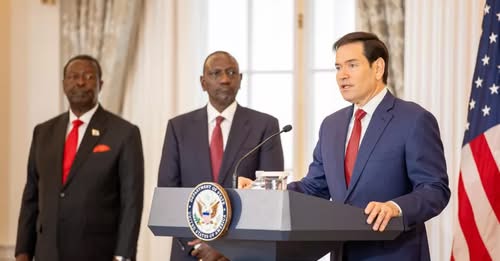
Defending the policy, US Secretary of State Marco Rubio said the administration wanted assistance to strengthen national institutions rather than flow through intermediary organizations.
“If we’re trying to help countries, help the country. Don’t help the NGO to go in and find a new line of business… So that is the model that we are breaking. We are not doing this anymore. We are not going to spend billions of dollars funding the NGO industrial complex while close and important partners like Kenya either have no role to play or have very little influence over how health care money is being spent,” Rubio said.
US officials say the strategy reflects a broader shift in American foreign policy, framing international assistance as an investment that advances both development goals and US strategic interests.
A State Department spokesperson defended the approach, saying the administration expects partner countries to recognize the broader economic and geopolitical objectives accompanying US assistance.
“The Trump administration has made clear US foreign assistance is not charity – rather, it is strategic capital to be wisely invested to advance US interests, and we expect all of our allies and recipient nations to take seriously American strategic and commercial priorities,” the spokesperson said.
Under the new framework, several African countries have already entered into agreements with Washington. Kenya has reportedly signed a US$1.6 billion health compact while committing approximately US$850 million in domestic funding. Tanzania has also agreed to a US$1.3 billion partnership alongside a reported US$1.8 billion local contribution.
The agreements are designed to gradually increase domestic financing for public health programmes over a five-year period, with participating governments expected to assume greater responsibility for funding disease prevention and treatment initiatives previously supported by US assistance.
However, the policy has generated debate in parts of Africa, where some governments have raised concerns about specific provisions contained in the proposed agreements.
Reports indicate that Ghana declined to sign a proposed US$109 million health compact after raising concerns over clauses relating to expanded public health data sharing and access to certain health-related biological materials. Zambian authorities have also reportedly paused negotiations over provisions that would link the health partnership to broader commercial arrangements involving access for US companies to critical mineral resources.
The Trump administration maintains that the revised model promotes sustainability by encouraging governments to invest more heavily in their own health systems while strengthening bilateral partnerships. Critics, however, argue that attaching broader strategic or commercial conditions to health financing could complicate international cooperation and place additional fiscal pressure on developing economies.
The shift marks one of the most significant changes to US global health financing in decades and is expected to reshape the way Washington engages with partner countries on public health programmes. As more nations consider the new agreements, the policy is likely to remain at the center of discussions on global development, healthcare financing and international diplomacy.