



By Perez Karisa, June 24, 2026
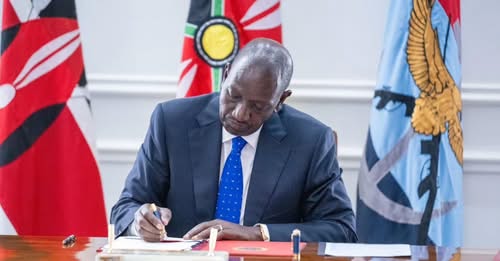
President William Ruto has signed the Finance Bill 2026 into law, ushering in a raft of tax reforms and fiscal measures aimed at supporting economic growth, easing the burden on Kenyans abroad and raising revenue to finance the country’s Sh4.8 trillion budget for the 2026/2027 financial year.
Among the most notable changes is a significant increase in the duty-free baggage allowance for returning travellers. Under the new law, Kenyans arriving from abroad will now be allowed to bring in personal effects and gifts worth up to Sh260,000 without paying customs duty, up from the previous limit of Sh39,000.
The new threshold effectively raises the allowance from the equivalent of 300 US dollars to 2,000 US dollars and is expected to benefit thousands of Kenyans living and working abroad, as well as returning residents and members of the diaspora.
Speaking during the signing ceremony at State House on Tuesday, President Ruto said the move was intended to address long-standing complaints over stringent inspections and taxation of luggage by the Kenya Revenue Authority (KRA), particularly at Jomo Kenyatta International Airport.
“The concerns raised by Kenyans in the diaspora regarding the treatment of personal effects and gifts have been taken into account. This new threshold provides relief and acknowledges the contribution of our citizens living abroad,” the President said.
Under the revised framework, imported personal belongings and gifts valued below Sh260,000 will be exempt from customs taxes. However, goods whose cumulative value exceeds the threshold will continue to attract normal customs duties and taxes.
The Finance Act 2026 also introduces several changes affecting different sectors of the economy.
Private sector employees will now enjoy a higher tax-free daily subsistence allowance after the government increased the limit from Sh2,000 to Sh10,000. The move is expected to benefit workers who regularly travel for official duties.
In the digital economy, the government has abolished the 1.5 percent Digital Service Tax (DST), replacing it with a Significant Economic Presence (SEP) framework targeting multinational technology firms operating in Kenya without physical offices.
The Act also provides relief to cryptocurrency traders by reducing the tax imposed on virtual asset transactions from three percent to 1.5 percent.
To protect local sugar producers, the government has sharply increased import duties on sugar from Sh7.50 to Sh40 per kilogram. Officials say the measure is intended to cushion domestic farmers and revive the local sugar industry from competition posed by cheaper imports.
In the aviation sector, taxes on aircraft spare parts intended for maintenance and repairs have been scrapped. The exemption is expected to strengthen Kenya’s position as a regional aviation hub and lower operational costs for airlines.
President Ruto used the occasion to dismiss widespread claims circulating on social media regarding alleged new taxes.
He clarified that the Finance Act 2026 does not introduce taxes on mobile money transactions such as M-Pesa, freehold land registration, second-hand clothes commonly known as mitumba, bottled water or mobile phones.
“There has been a lot of misinformation regarding this Bill. I want to assure Kenyans that some of the claims being circulated are false. There are no new taxes on M-Pesa, mobile phones, bottled water or mitumba,” he said.
The enactment of the Finance Act comes at a time when the government is seeking to balance revenue collection with public concerns over the cost of living and economic pressures facing households and businesses.
Treasury officials say the new law is designed to widen the tax base, promote investment and stimulate growth while ensuring the government raises sufficient resources to fund development projects and essential public services.
The implementation of the Act now shifts to various government agencies, including the Kenya Revenue Authority, which will be tasked with operationalizing the new provisions.