


By Fridah Mbuvi, June 29, 2026
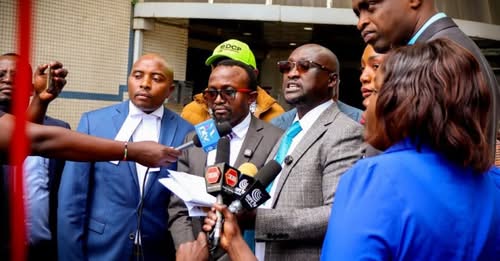
Opposition leaders have formally petitioned the Independent Electoral and Boundaries Commission (IEBC), accusing President William Ruto’s administration of illegally using state resources to influence the upcoming Ol Kalou parliamentary by-election scheduled for July 16.
The complaint comes as the by-election has evolved into one of the country’s most politically significant contests, serving as a key test of influence in the Mt. Kenya region following the political fallout between President William Ruto and his former Deputy President, Rigathi Gachagua.
Led by Gatanga MP Edward Muriu, opposition lawmakers and lawyers have asked the IEBC to summon several Cabinet Secretaries and Principal Secretaries over what they describe as blatant violations of electoral laws. They argue that taxpayer-funded government projects are being branded with United Democratic Alliance (UDA) campaign imagery and used to advance the ruling party’s candidate during the official campaign period.
The opposition further alleges that public officers have been using official government functions to openly campaign for UDA candidate Samuel Muchina Nyaga, contrary to constitutional and electoral provisions requiring public servants to remain politically neutral while executing their official duties.
Among the officials named in the complaint are Lands Cabinet Secretary Alice Wahome, ICT Cabinet Secretary William Kabogo, Tourism Cabinet Secretary Rebecca Miano, Roads Cabinet Secretary Davis Chirchir and Lands Principal Secretary Nixon Korir. The petition urges the electoral commission to investigate their conduct and take appropriate action to ensure a level playing field for all candidates.
The allegations come against the backdrop of an intensive government development drive across Ol Kalou in the weeks leading up to the vote. Senior Cabinet officials have repeatedly visited the constituency to commission infrastructure, housing, education and digital connectivity projects, which the government maintains are part of its ongoing national development agenda rather than campaign activities.
Roads Cabinet Secretary Davis Chirchir and Tourism Cabinet Secretary Rebecca Miano recently launched the upgrading of the 23-kilometre Kwa Haraka–Kageraini road and the 37-kilometre Ithagani–Ngorika road, projects aimed at improving transport and boosting economic activity in the region.
Lands Cabinet Secretary Alice Wahome also launched the Ol Kalou Affordable Housing Project and commissioned a modern market, while ICT Cabinet Secretary William Kabogo unveiled digital internet hubs in Wiyumiririe, Passenga and Mirangine as part of the government’s digital transformation programme.
In addition, the government commissioned new hostels at the Ol Kalou Technical and Vocational College and officially launched Nyandarua University, initiatives it says are intended to expand access to higher education and create new opportunities for residents.
Government officials have defended the projects, insisting they are routine development programmes that had been planned long before the by-election was announced. They have dismissed accusations that the initiatives are intended to sway voters.
The parliamentary seat fell vacant following the death of MP David Kiaraho in March 2026. Although the IEBC cleared nine candidates to contest the election, political observers view the race as a direct contest between President Ruto’s Kenya Kwanza administration and the opposition alliance led by Rigathi Gachagua.
UDA has fielded Samuel Muchina Nyaga, whose campaign has received strong backing from President Ruto and senior government officials. His main challenger is Sammy Kamau Ngotho of the Democracy for Citizens Party (DCP), who has secured the support of Gachagua and a united opposition coalition seeking to consolidate its influence across the Mt. Kenya region.
Political analysts believe the outcome of the by-election will carry significance beyond the constituency itself, with the contest expected to provide an early indication of shifting political loyalties ahead of the 2027 General Election.
As campaigns intensify, attention is now focused on the IEBC, which is under pressure to determine whether the government’s activities amount to legitimate public service delivery or constitute an unlawful use of state resources to influence the electoral process. The commission’s handling of the opposition’s complaint is expected to shape public confidence in the conduct of the by-election and could have wider implications for campaign practices in future elections.