


By Mumo Judah, June 9, 2026
Anti-riot police in Nanyuki fired tear gas and arrested several demonstrators on Tuesday as protests intensified over the ongoing construction of a U.S.-funded Ebola quarantine and isolation facility at the Laikipia Air Base, a project that has sparked widespread public outrage and political tension.
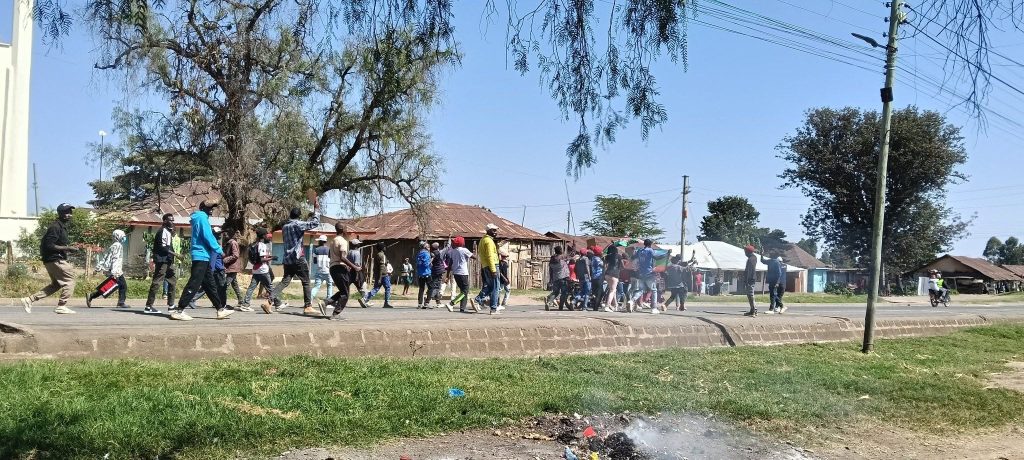
The demonstrations brought business activity in the central resort town to a standstill as residents marched through the streets demanding an immediate halt to the project, which they accuse both the Kenyan government and the United States of imposing without adequate public consultation.
Witnesses said the protests escalated rapidly into running battles as security forces moved in to disperse crowds attempting to march toward the town centre. Protesters were seen waving Kenyan flags, carrying symbolic mock coffins labelled “Ebola,” and wearing protective medical gear in what organisers described as a peaceful but firm expression of resistance.
Police responded with tear gas canisters, forcing crowds to scatter through surrounding streets. Several arrests were made during the operation, though authorities did not immediately disclose the number of those detained.
“We are not criminals. We are defending our lives and our town. This facility threatens everything we depend on,” one protester said during the chaos.
The unrest comes just days after earlier demonstrations on June 1, during which two people were reportedly shot dead near the Laikipia Air Base, further escalating tensions in the region.
At the centre of the dispute is a proposed 50-bed Ebola isolation and quarantine facility being constructed within the military base. According to project details, the centre is intended to house asymptomatic U.S. citizens exposed to Ebola outbreaks in Uganda and eastern Democratic Republic of Congo, before they are repatriated or cleared for travel.
The decision to host the facility in Kenya has drawn strong criticism from residents and activists, who argue that the country is being used as a buffer zone for foreign biosecurity risks.
Opposition has also been fueled by statements attributed to U.S. officials indicating a shift in policy, with concerns raised that exposed individuals are being diverted away from the United States and relocated to partner countries instead.
Adding to public anger are allegations that construction work has continued despite a High Court order temporarily halting the project pending a constitutional review. Residents claim that white tent structures and ongoing activity at the site indicate that development has not stopped.
Local leaders have also expressed frustration over what they describe as a lack of consultation. Laikipia Senator John Kinyua said regional representatives were not informed about the project in advance.
“No one told us about this quarantine facility in Laikipia. Elected leaders in this region were completely blindsided by the development,” he said.
Business owners in Nanyuki say the unrest has severely disrupted tourism and trade, two of the town’s key economic drivers. Hotels, shops, and transport services were forced to close temporarily as police and protesters engaged in confrontations across major roads.
Activists, meanwhile, insist their demonstrations are rooted in safety concerns, warning that introducing a high-risk infectious disease containment facility could have long-term consequences for public health, wildlife tourism, and investor confidence in the region.
As tensions continue to rise, security remains heightened in and around Nanyuki, with authorities warning against further unlawful demonstrations while residents vow to continue opposing the project until their concerns are addressed.