



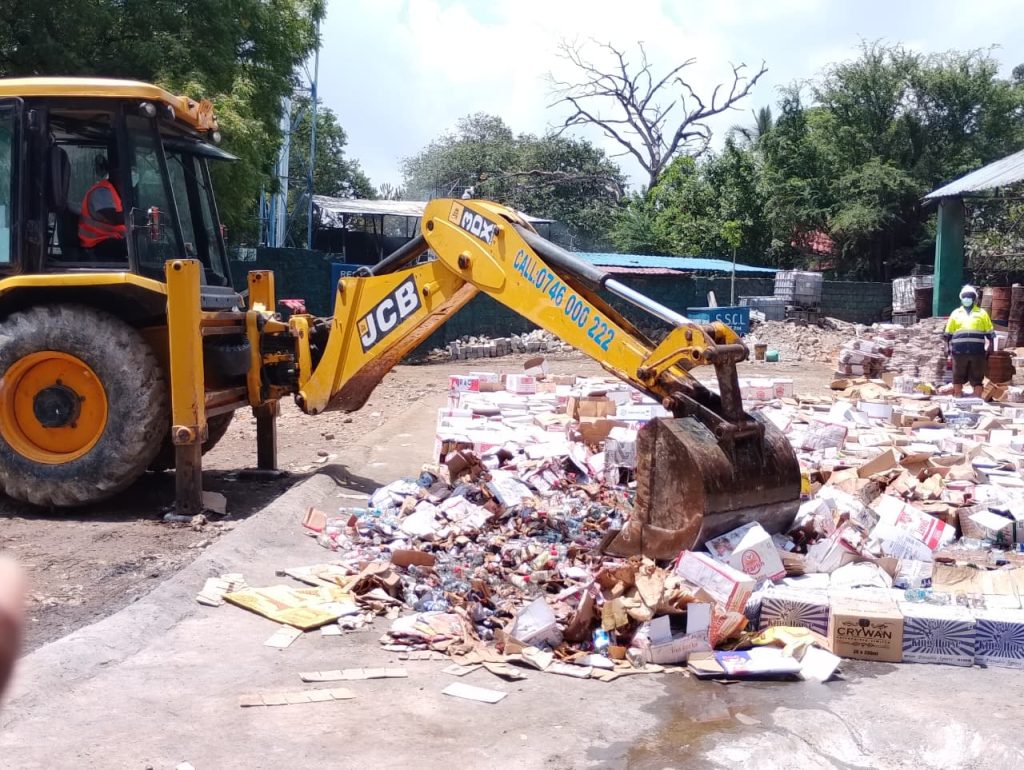

The Anti-Counterfeit Authority (ACA) has destroyed substandard goods worth approximately KSh104 million in Saimbot, Mombasa County, as the government intensifies its crackdown on illicit trade.
The exercise, which is the second major destruction exercise conducted by the authority this year, involved various products seized from different parts of the country, including motor vehicle spare parts, beverages and other goods found to violate quality standards and intellectual property rights.
Speaking during the exercise, ACA Executive Director Dr Robi M. King’a said alcoholic drinks valued at approximately KSh14 million were among the products being destroyed, warning that illicit alcohol posed a serious threat to public health, particularly among young people.
He urged manufacturers and brand owners to work closely with the authority by providing intelligence and information that could help identify counterfeit products and those involved in their distribution.
“The war against counterfeiting cannot be won by ACA alone,” said Dr King’a, calling for cooperation among consumers, manufacturers, law enforcement agencies and the media.
He also revealed that the authority was preparing regulations to introduce a track-and-trace and authentication system for alcoholic beverages. The proposed system will require each container to carry a special identifier, enabling authorities to trace products from the manufacturing stage through distribution to the point of consumption.
Dr King’a explained that the regulations would be submitted to Parliament and subjected to public participation before implementation.
He further disclosed that the destruction exercise involved approximately 58 case files representing individual cases of counterfeit goods seized across the country. According to him, offenders may face criminal prosecution through the Office of the Director of Public Prosecutions (ODPP) or opt for a compounding process, which involves admitting the offence and paying the prescribed fines.
He said first-time offenders could be fined three times the value of the counterfeit goods, while repeat offenders could face fines amounting to five times their value. The compounding process takes approximately two to three months, compared to court proceedings that may take up to three years.
With the festive season approaching, Dr King’a urged consumers, bars and distributors to remain vigilant and report suspicious alcoholic products. He warned that unusually low prices compared to the normal market rate could be an indication that a product is counterfeit.
ACA Board of Directors Chairperson Hon. Nelson Ributhi Gaichuhie said the goods involved in the exercise were worth approximately KSh104 million and had been seized from various parts of the country.
He called on the media to play an active role in exposing counterfeit trade, noting that public awareness and information sharing were essential in the fight against the vice.
The Industrialisation Secretary, Professor Elias Kasgathebe, who represented the Ministry of Investments, Trade and Industry, said counterfeit products undermine legitimate businesses, discourage investment, weaken fair competition and deny the government revenue.
He cited estimates indicating that approximately 40 per cent of alcohol in the market is counterfeit, warning that fake food, drinks and water also pose serious health risks to consumers.
Professor Kasgathebe said the government was working with the Directorate of eCitizen to develop a product identification system based on unique registered trademarks, which would complement the ACA’s proposed track-and-trace system.
“This is a national call. We do it together and we will succeed,” he said, urging Kenyans to support efforts aimed at eliminating counterfeit products.
Meanwhile, Kenya Association of Manufacturers (KAM) Chief Executive Officer Tobias Alando said illicit products continue to threaten public health, deprive the government of revenue and create unfair competition for legitimate manufacturers.
Citing previous studies, Alando said approximately 40 per cent of products consumed locally were illicit, stressing the need for stronger collaboration between the government, manufacturers and the public.
He welcomed the destruction exercise and reaffirmed KAM’s commitment to supporting the authority’s monthly initiatives aimed at eliminating counterfeit goods.
“If we work together, Kenya will move forward,” said Alando.
The ACA says counterfeit trade accounts for a significant share of the Kenyan market, with legitimate businesses losing market share to illicit operators. Motor vehicle spare parts are among the commonly encountered counterfeit products, raising safety concerns, while illegally sold alcoholic drinks continue to feature prominently in enforcement cases.
The exercise comes ahead of the third International Symposium on Intellectual Property Protection and Enforcement (ISIPPE-3), which is scheduled to take place in Mombasa from November 18, 2026, as part of activities marking Intellectual Property Rights Week.


